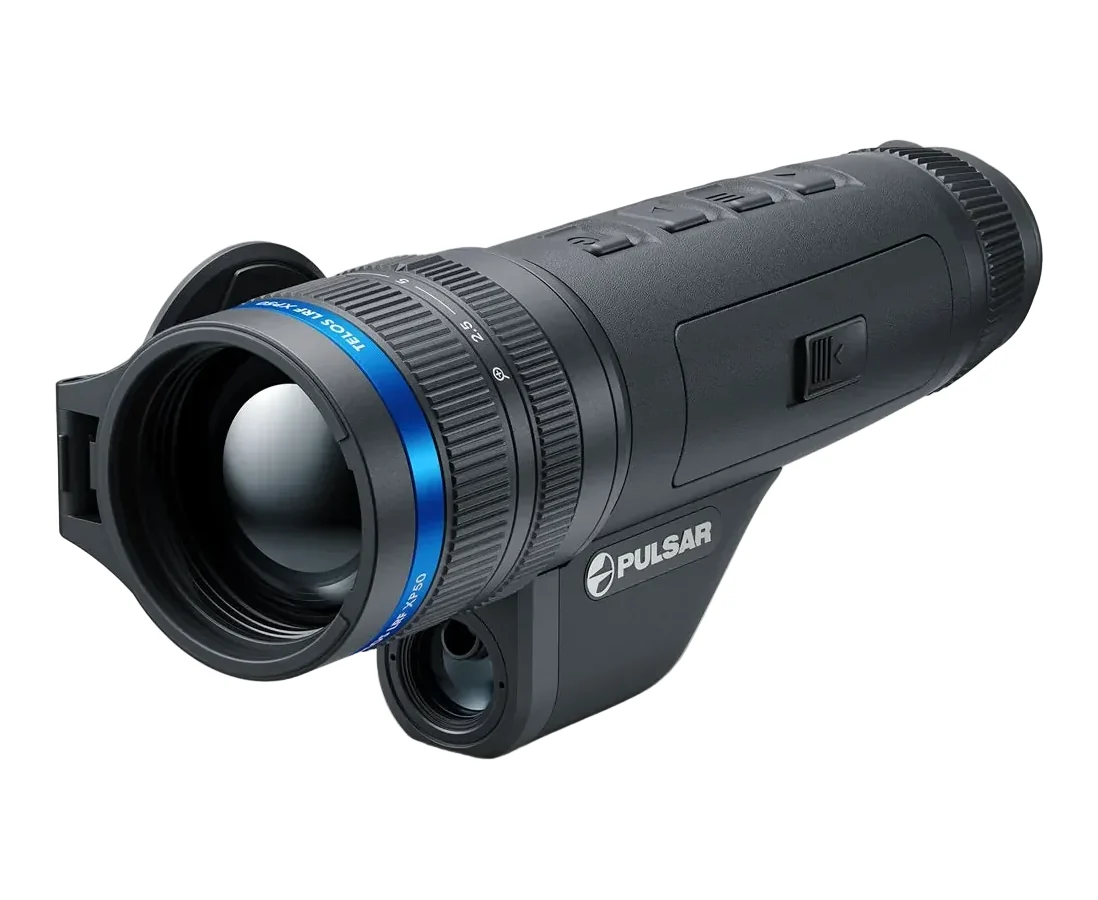
Pulsar Telos LRF XP50
8.9Very good · out of 10- 640×480 sensor, 50 mm lens
- Computed reach: 1,765 m
- Checked price: $3,699.97
Images: Pulsar
Pulsar · Thermal monocular · No. 3 of 14 in our ranking
8.9Very good · out of 10The long-range tool: a 50 mm lens, the lowest NETD Pulsar lists here and 8.5 hours on one pack.
Pulsar US store, price checked on November 9, 2026
| Brand | Pulsar |
|---|---|
| Model | Telos LRF XP50 |
| Sensor | 640×480 px, 17 µm pixel pitch, 50 Hz |
| Sensitivity (NETD) | Sensor NETD <18 mK, sNETD <15 mK (Pulsar US page); the higher figure is scored |
| Objective lens | 50 mm F1 |
| Magnification | 2.5-10x (x4 digital zoom) |
| Horizontal field of view | 12.4° |
| Stated detection range | 1,800 m for a 1.8 m tall object, Pulsar figure |
| Computed reach (our formula) | 1,765 m (1,930 yd): 50 mm ÷ 17 µm × 1.8 m ÷ 3 px |
| Display | AMOLED HD 1024×768 |
| Laser rangefinder | Yes, up to 1,000 m (1,094 yd) |
| Battery | LPS 7i Li-ion pack, 6,400 mAh, up to 8.5 h at 22 °C (Pulsar figure) |
| Recording | Photo and video, 64 GB built in |
| Wi-Fi app | Yes |
| Weight | 720 g (25.4 oz), 25.4 oz as listed by Pulsar US |
| Water protection | IPX7 |
| Warranty | 3-year factory warranty, 5 years with free registration for US purchases (Pulsar US warranty page) |
| Checked price | $3,699.97 on November 9, 2026 |
| Availability | In stock at the official US store |
Not stated by the manufacturer.
In stock at the official US store.
| Pulsar US store ↗ | $3,699.97 |
|---|
Official Pulsar product page ↗
Some links are affiliate links: we may earn a commission at no extra cost to you. It never changes our scores. Affiliate disclosure
Score out of 10 from Pulsar's published figures and the checked US price, with the same 10 criteria for every monocular. A criterion without a figure is left out and the other weights are rescaled.
| Raw score (weighted average) | 7.8/10 |
|---|---|
| Displayed score (editorial scale) | 8.9/10 |
| Sensor resolution (20%) | 9.3/10 |
|---|---|
| Reach (lens / pixel pitch) (15%) | 9.0/10 |
| Thermal sensitivity (NETD) (10%) | 9.4/10 |
| Display resolution (5%) | 8.0/10 |
| Battery life (10%) | 8.3/10 |
| Weight (with battery) (10%) | 5.3/10 |
| Laser rangefinder (5%) | 10.0/10 |
| Water protection (5%) | 10.0/10 |
| Warranty (5%) | 7.5/10 |
| Price (15%) | 3.2/10 |
By Jake Turner, the editorial team · Updated November 9, 2026
Thermal monocular, rated "Very good" by our formula: 8.9/10.
The two alternatives we would look at next, with their key figures.
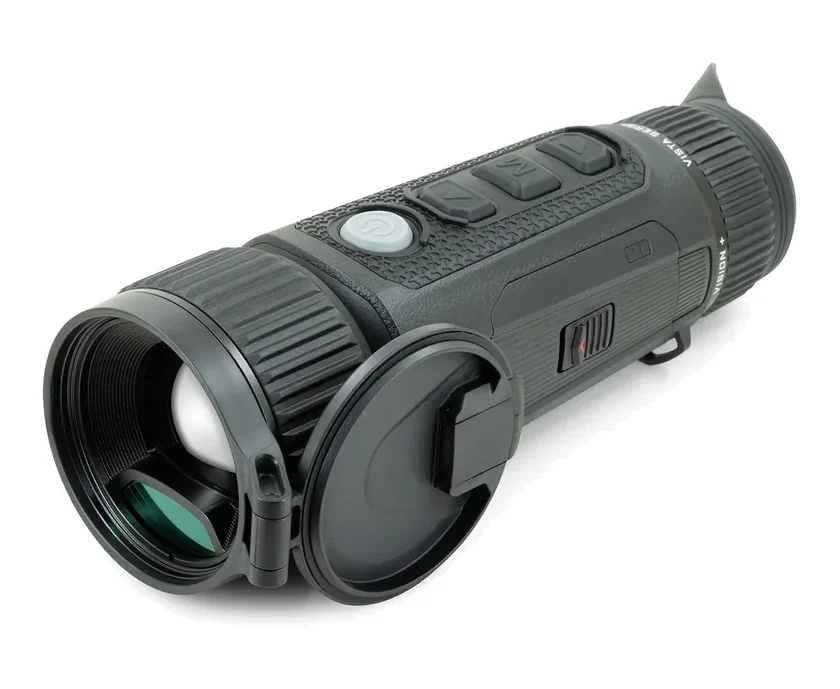
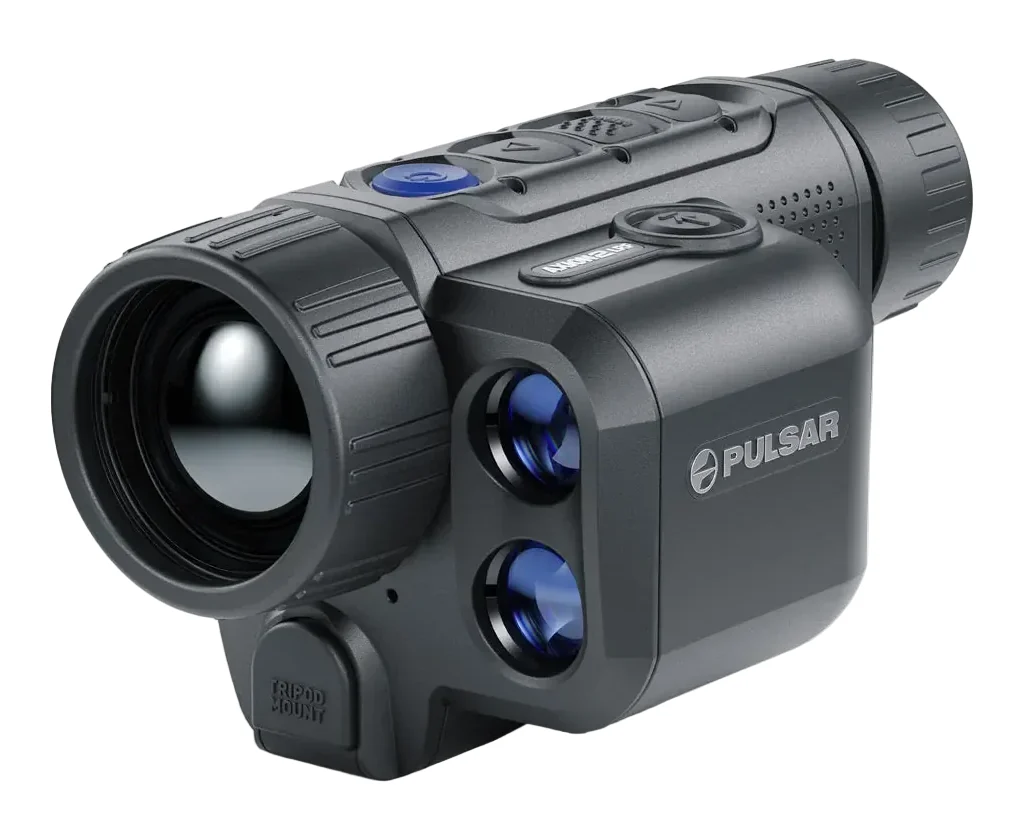
Sensor (17 µm pixels) and lens stated by Pulsar, NETD 18 mK (the figure we score). With our formula (focal length ÷ pixel pitch, 3 pixels on a 1.8 m target) that gives a computed reach of 1,765 m.
Pulsar lists a 640×480 sensor with 17 µm pixels, a 50 mm germanium lens, 2.5 to 10x with 4x digital zoom and a 1024×768 AMOLED HD screen. Pulsar says a 1.8 m object can be detected up to 1,800 m away in complete darkness.
Our calculator lands close: about 2,650 m for 2-pixel detection of a person, and recognition of a coyote-sized target at about 370 m (400 yd). The 17 µm pixels are bigger than the 12 µm of newer sensors, which is why the 50 mm lens only buys the same reach as a 35 mm lens on 12 µm pixels. What the bigger pixels and the low NETD give back is sensitivity: the Telos scores 9.4/10 on that line.
The rest suits long sits: a 6,400 mAh LPS 7i pack rated at 8.5 hours, USB-C power delivery for a power bank, 64 GB of storage and IPX7 waterproofing. The laser is the same 905 nm, 1,000 m, ±1 m class as the Axion 2 LRF.
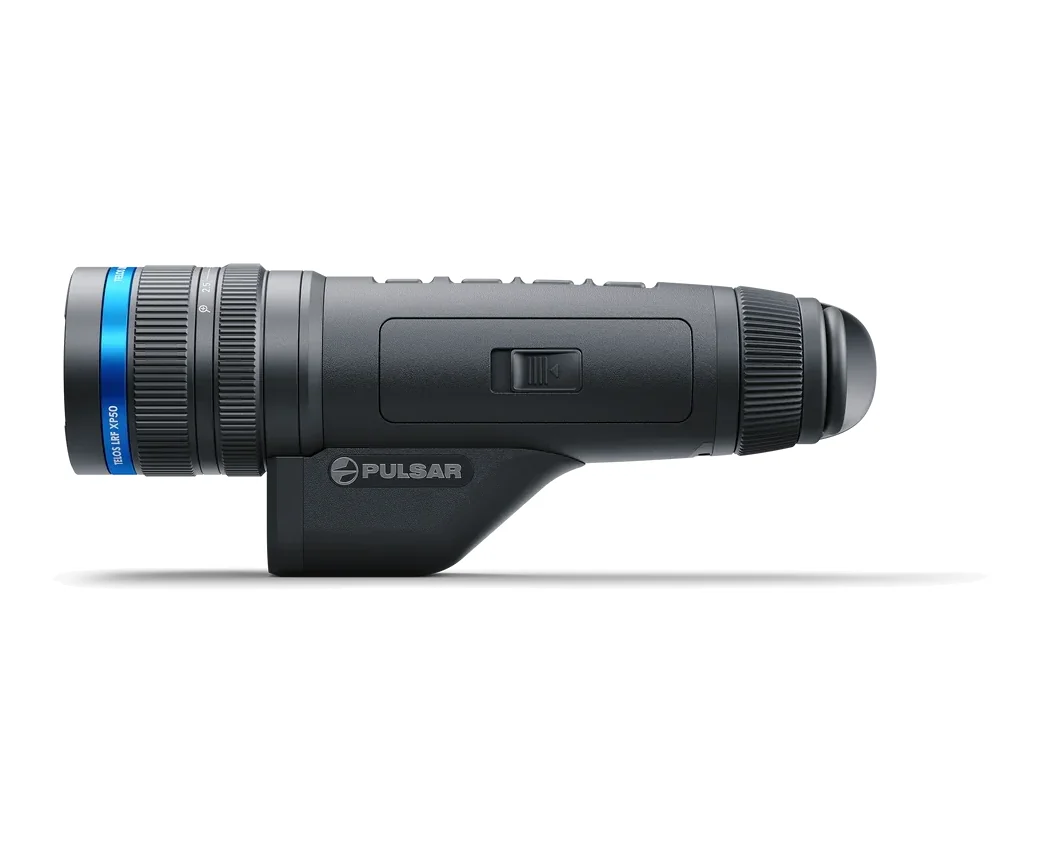
Size. Pulsar US lists the Telos at 25.4 oz (720 g) and 9.4 inches long. That makes it the heaviest device we compare, and it shows in our weight score (5.3/10). You will want a chest harness or a strap.
Price, again. At $3,699.97 it is the most expensive model in our list, which costs it on the overall score. If you do not hunt beyond 400 yards, a lighter 384 or 640 model at half the price does the same job most nights.
Points taken from the official US product page.
Sensitivity: Sensor NETD <18 mK, sNETD <15 mK (Pulsar US page); the higher figure is scored. Battery: LPS 7i Li-ion pack, 6,400 mAh, up to 8.5 h at 22 °C (Pulsar figure). Photo and video recording to 64 GB of built-in memory. Laser rangefinder up to 1,000 m (1,094 yd), as stated by Pulsar.
US price checked on November 9, 2026 at the Pulsar US store: $3,699.97. The price at the store is the one that applies.
The Telos LRF XP50 was in stock at $3,699.97 on the Pulsar US store on November 9, 2026, with free shipping over $1,000 and a 3-year warranty (5 years with registration). Before you buy, compare it with the Nocpix Vista H35R: $400 less, a sharper screen and a 5-year warranty, but 3 hours less battery.
For hunters who glass big open ground, the Pulsar Telos LRF XP50 is the long-range scout to get: a 640×480 sensor with the lowest NETD Pulsar lists here (<18 mK sensor, <15 mK system), a 50 mm F1.0 lens, a 1,000 m laser and 8.5 hours on one pack. It ranks first for hunting (9.2/10) and 8.9 overall. It is also the most expensive ($3,699.97) and, at 25.4 oz, a two-hand device.
Pulsar US store
The Telos LRF XP50 next to the two rivals above, from the official spec sheets and the US prices checked on November 9, 2026.
| Pulsar Telos LRF XP50 | Pulsar | 8.9 | $3,699.97 | 640×480 · 50 mm · 720 g | Wi-Fi app | 3 years |
| Nocpix Vista H35R | Nocpix | 9.0 | $3,300 | 640×512 · 35 mm · 640 g | Wi-Fi app | 5 years |
| Pulsar Axion 2 LRF XG35 | Pulsar | 8.9 | $2,999.97 | 640×480 · 35 mm · 350 g | Wi-Fi app | 3 years |
Telos LRF XP50 gets 8.9/10 with our overall weights, from a raw weighted average of 7.8/10. The scales are on the methodology page.
Weight: 20% of the overall score
Weight: 15% of the overall score
Weight: 15% of the overall score
Weight: 10% of the overall score
By use, with the same figures and other weights: for hunting 9.2/10 (No. 1), with rangefinder 9.0/10 (No. 3).
Yes, it ranks first in our hunting ranking at 9.2/10, thanks to its 640 sensor, low NETD, long lens and laser rangefinder. It suits open ground better than thick woods.
Pulsar rates the LPS 7i pack (6,400 mAh) at up to 8.5 hours at 22 °C. It also runs from a USB-C power bank (5 V or 9 V Power Delivery).
The Telos has a lower NETD, a longer battery and a 50 mm lens on 17 µm pixels; the Axion 2 LRF reaches about as far with a 35 mm lens on 12 µm pixels in a body half the weight, for $700 less at list price.
8.9/10 ("Very good") with our overall formula, No. 3 of 14 in our main ranking. The score comes from 10 criteria read on the official spec sheet and the checked US price.
Our button goes to the Pulsar US store, where we read the price on November 9, 2026. The link goes straight to the store.
Official pages read on November 9, 2026: pulsarnv.